AUMA Elects New Executive Committee and Reinforces its Strategic Role in Urban Mobility Governance
Online
November 18, 2025
Urban Transport & Mobility
Newsletters
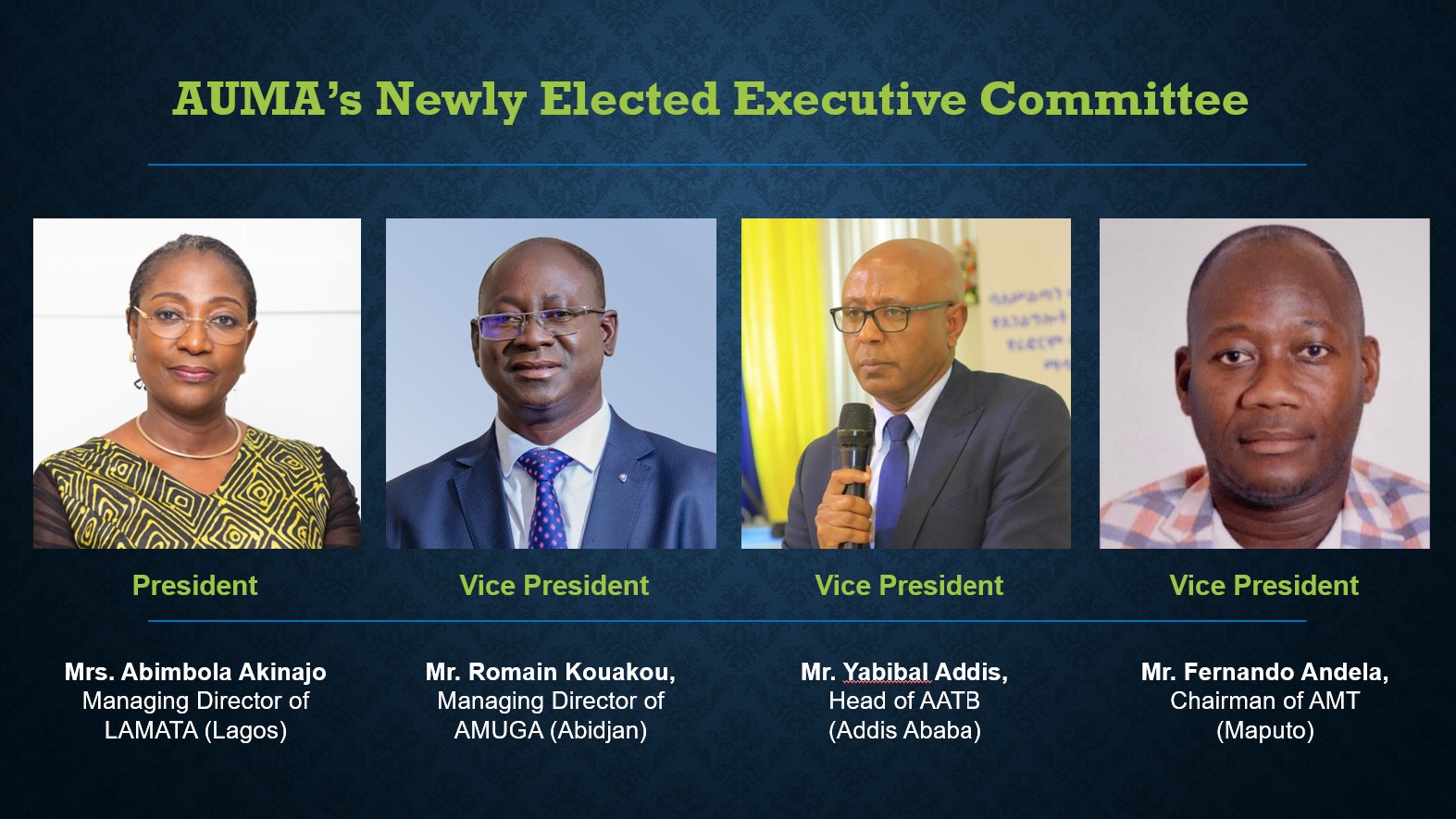
The African Association of Urban Mobility Authorities (AUMA) has elected a new Executive Committee, marking an important milestone in consolidating the association and reaffirming its role as a continental platform for cooperation among urban mobility authorities.
At an Extraordinary General Assembly held in November 2025, members elected Abimbola Akinajo, Managing Director of the Lagos Metropolitan Area Transport Authority (LAMATA), as President of AUMA. She is joined by three Vice Presidents representing different regions of the continent: the urban mobility authority of Greater Abidjan (AMUGA) as First Vice President, the Maputo Metropolitan Transport Agency (AMT) as Second Vice President, and the Addis Ababa Transport Bureau (AATB) as Third Vice President. To streamline the Association’s operations, LAMATA will also host AUMA’s Executive Secretariat.
Reflections from the Outgoing President
In his address to the General Assembly, the outgoing President, Thierno B. Aw, reflected on AUMA’s trajectory since its establishment and outlined the challenges ahead. He highlighted the importance of strengthening the association’s institutional foundations, expanding partnerships, and ensuring that AUMA remains responsive to the practical needs of its members as urban mobility reforms accelerate across African cities.
His remarks framed the leadership transition as an opportunity to move from establishment to consolidation, with a stronger focus on sustainability, relevance, and impact.
Strengthening AUMA as a Member-Driven Organization
Under the newly elected Executive Committee, the first set of priorities focuses on strengthening AUMA as a member-driven organization. This includes efforts to expand membership, enabling more urban mobility authorities to participate in the network and benefit from structured peer exchange. Broader membership serves as a key lever for reinforcing AUMA’s representativeness and deepening learning across diverse institutional and geographic contexts.
The Executive Committee also identified the need to diversify funding sources and improve communication, both within the membership and with external partners. Strengthening these organizational dimensions is essential to sustaining AUMA’s activities over time and positioning the association as a credible and visible platform for urban mobility governance in Africa.
Scaling Up Technical Activities and Peer Learning
Alongside organizational consolidation, the new Executive Committee is placing strong emphasis on scaling up AUMA’s technical activities, with a particular focus on knowledge exchange, capacity building, and peer learning. AUMA seeks to provide more structured opportunities for members to share practical experience on issues such as institutional design, regulatory frameworks, planning and coordination functions, and the oversight and management of public transport systems.
By facilitating exchanges among authorities facing similar governance challenges, the association aims to accelerate learning, promote context-appropriate solutions, and support members in strengthening their institutional effectiveness.
A Key Platform Aligned with the SUMA Governance Agenda
SSATP has played a central role in supporting AUMA since its foundation, providing technical support and serving as a convening partner during its establishment and early development. AUMA has progressively emerged as a key partner for the delivery of SSATP’s Sustainable Urban Mobility and Accessibility (SUMA) activities under its Fourth Development Plan (DP4), particularly in the thematic area of governance.
Through AUMA, SSATP engages directly with the public authorities responsible for planning, regulating, and managing urban mobility systems, and supports peer-to-peer learning grounded in real institutional practice. As DP4 places increasing emphasis on strengthening governance, institutions, and coordination mechanisms, AUMA offers a practical and scalable platform to translate knowledge into action across African cities.
With a new Executive Committee in place and a clarified set of priorities, AUMA enters its next phase with a renewed mandate — to consolidate the association as a sustainable, member-driven organization and deliver tangible value to its members while supporting broader continental efforts to improve urban mobility governance.