Advancing Maritime Single Windows in Francophone Africa: From Fragmented Procedures to Coordinated Clearance
Abidjan
Cote d'Ivoire, Cameroon, Comoros, Congo, Democratic Republic of, Gabon, Guinea, Madagascar, Mauritania, Senegal, Togo
December 09, 2025
- December 12, 2025
Regional Integration
Events
Efficient ports are essential to Africa’s economic connectivity and trade facilitation. Yet in many countries, ships still face fragmented reporting requirements, paper-based procedures, and duplicative controls across maritime administrations, port authorities, customs, and border agencies. These fragmented processes add time and uncertainty to port calls and complicate vessel clearance.
Maritime Single Windows (MSWs) are designed to address this challenge. By enabling ship agents to submit standardized regulatory information through a single digital entry point, MSWs help streamline vessel clearance, strengthen coordination among authorities, and improve the transparency of maritime and port operations. MSW implementation is also a requirement under the International Maritime Organization’s Convention on Facilitation of International Maritime Traffic (FAL Convention), creating a clear imperative for countries to modernize their ship clearance systems.
Across Africa, however, progress has been uneven. While digital platforms have been introduced in several ports, implementation is often constrained by institutional fragmentation, limited coordination among stakeholders, and misalignment between digital systems and existing clearance processes. In many cases, the challenge is not technological alone, but institutional.
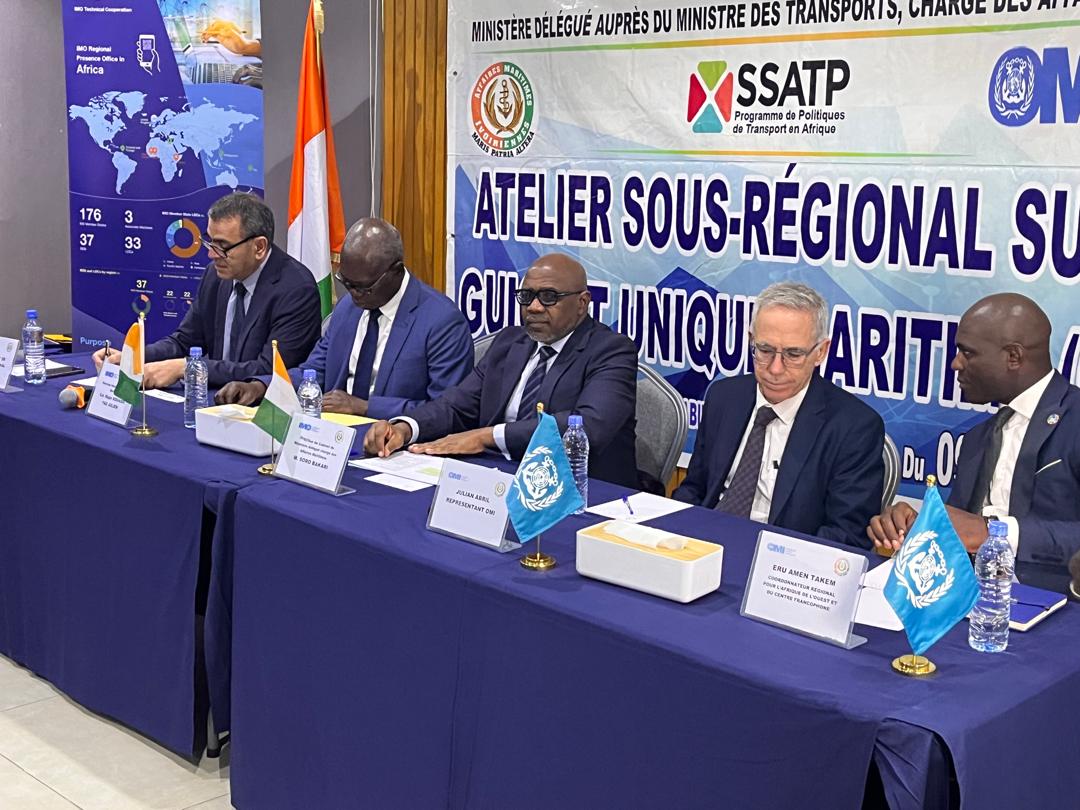
It was in this context that the Maritime Single Window Workshop, held in Abidjan from December 9-12, 2025, provided a practical forum for countries to examine these challenges and deepen their understanding of what effective MSW implementation requires.
A sub-regional forum focused on implementation
The workshop was co-organized by the International Maritime Organization (IMO), the Africa Transport Policy Program (SSATP), and the World Bank, and delivered through IMO’s Integrated Technical Cooperation Programme (ITCP), in close collaboration with Côte d’Ivoire’s Directorate General of Maritime and Port Affairs.
It brought together 79 participants, including 20 women, from Benin, Cameroon, Comoros, Congo, Côte d’Ivoire, the Democratic Republic of Congo, Gabon, Guinea, Madagascar, Mauritania, Senegal, and Togo, representing maritime administrations, port authorities, and customs agencies. Regional port organizations—including the Port Management Association of West and Central Africa (PMAWCA), the Port Management Association of Eastern and Southern Africa (PMAESA), the Union of Port Administrations of Northern Africa (UAPNA), and the African Harbor Masters Committee—also participated, alongside the African Alliance for Electronic Commerce (AAEC) and representatives from the African Development Bank (AfDB).
From assessment to implementation pathways
Discussions were grounded in IMO-led needs assessment missions carried out in Benin, Côte d’Ivoire, Guinea, Liberia, Mauritania, Sierra Leone, and Togo. These assessments included functional analysis of existing ship clearance systems, identifying key challenges and targeted recommendations for MSW deployment.
Building on this analytical foundation, participating countries presented their current port and clearance systems, enabling structured peer exchange on progress made, constraints encountered, and implementation choices. These presentations highlighted common challenges—particularly related to coordination, sequencing, and interoperability—while also reflecting the diversity of national contexts.
Across these exchanges, one clear conclusion emerged: MSWs are not standalone digital solutions. Participants emphasized that MSWs are most effective when embedded within broader trade facilitation ecosystems and aligned with an existing Port Community System or Trade Single Window, requiring institutional coordination and process alignment alongside digital development.
Structuring reform through practice and peer learning
Technical sessions then focused on how to operationalize MSW implementation. Discussions addressed business process reengineering, interoperability, compliance with the FAL Convention, and port efficiency, using the SSATP MSW checklist outlined in Catching Up on Digital Port Infrastructure for Africa as a practical framework. This checklist helped structure conversations around political commitment, designation of a lead agency, selection of an operating model, stakeholder engagement, and the reengineering of vessel clearance and port call processes.
African MSW case studies from Mauritius, Djibouti, and Morocco illustrated different approaches to sequencing reforms and coordinating stakeholders, reinforcing the value of peer learning in moving from assessment to implementation.
In a keynote intervention, Jan Hoffmann highlighted the importance of digital port infrastructure as a component of broader port reform and underscored the role of data in supporting port efficiency, referencing indicators such as the Container Port Performance Index, Logistics Performance Index 2.0, and the Global Supply Chain Stress Index.
Discussions also covered technical assistance and financing considerations, with contributions from SSATP, the World Bank, and the African Development Bank Group. Representatives of regional port associations, including the Port Management Association of West and Central Africa and the Union of Port Administrations of Northern Africa, shared perspectives on the challenges of digitalization in African port environments.
Key takeaways from the Abidjan workshop
- MSWs are institutional reforms, not just IT systems. Effective implementation requires coordination across agencies and alignment with existing port and trade facilitation systems.
- Business process reengineering is essential. Functional analysis and process simplification are core steps in MSW design and deployment.
- Clear leadership and governance matter. Designation of a lead agency and sustained stakeholder engagement underpin progress.
- Peer learning supports implementation. Country exchanges help identify practical solutions and avoid fragmented approaches.
- Technical assistance and financing are integral. MSW implementation benefits from structured support alongside technical design.
Looking ahead
By convening policy makers, port practitioners, and regional organizations, the Abidjan workshop strengthened shared understanding of what MSW implementation involves in practice. It reaffirmed that advancing Maritime Single Windows requires coordination, sequencing, and sustained institutional engagement, rather than isolated digital initiatives.
Building on this momentum, IMO, SSATP, and the World Bank plan to organize two additional MSW workshops in 2026 for English- and Portuguese-speaking African countries, with sessions envisaged in Dar es Salaam and Accra, further extending opportunities for peer learning and implementation support.